How Max Verstappen Became the Dominant Force in Formula 1
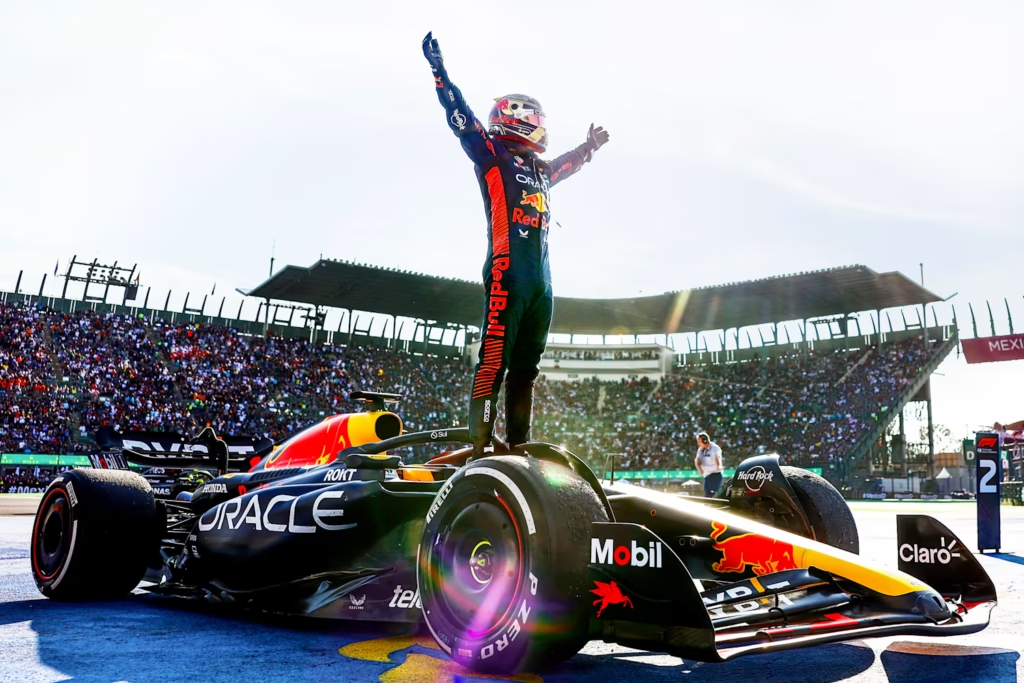
Max Verstappen’s rise to supremacy in Formula 1 represents one of motorsport’s most remarkable trajectories, characterized by exceptional speed, tactical intelligence, and the ability to extract maximum performance from any competitive machinery. Understanding how a driver progresses from promising rookie to multiple world champion involves examining the convergence of natural talent, strategic team partnerships, technical innovation, and competitive timing. This analysis explores the specific factors and milestones that established Verstappen as the sport’s dominant figure across multiple seasons.
Early Talent Recognition and the Path to Red Bull Racing
Max Verstappen’s dominance began long before his Formula 1 debut, rooted in a systematic development through junior categories where he demonstrated exceptional racecraft and consistency. Born in 1997, Verstappen progressed through Formula 3 and Formula 2 with remarkable efficiency, winning championships and securing Pole Positions at unprecedented rates for his age. His progression through these feeder series—where drivers develop fundamental car control, race strategy, and competitive psychology—provided the foundational skills that would later distinguish him in Formula 1.
Red Bull Racing’s decision to promote Verstappen to the main Formula 1 grid at age seventeen through Toro Rosso (Red Bull’s sister team) in 2015 proved strategically significant. The team recognized his raw speed and invested in his development, understanding that early exposure to Formula 1 machinery, even in a less competitive environment, would accelerate his learning curve. By 2016, after demonstrating consistent improvement and occasional flashes of brilliance, Verstappen moved directly to the senior Red Bull team, where he would have access to superior machinery and resources essential for championship contention.
Technical Mastery and Adaptive Driving Style
Verstappen’s dominance fundamentally rests on his technical precision and remarkable ability to adapt his driving style to different car characteristics and competitive conditions. Unlike drivers who excel in specific mechanical setups or rely on particular handling characteristics, Verstappen extracts performance from diverse vehicle configurations—a skill that became increasingly valuable as regulations evolved and teams pursued different aerodynamic philosophies. His feedback to engineers demonstrates sophistication in understanding how suspension geometry, tire compound selection, fuel loads, and brake balance interact to produce competitive lap times.
This technical versatility became evident during the 2021 championship battle against Lewis Hamilton, where Verstappen demonstrated equal competitiveness on high-downforce circuits requiring precision and low-downforce tracks demanding bravery and smooth inputs. The Abu Dhabi Grand Prix finale illustrated his capacity to maintain focus and execute perfect laps under extreme pressure, securing the world championship through superior performance in the final lap of the season. His willingness to experiment with unconventional setups and his confidence in communicating specific handling preferences to his engineering team accelerated his development beyond typical driver progression timelines.
The Red Bull Advantage and Sustained Partnership
Verstappen’s sustained dominance correlates directly with Red Bull Racing’s technical innovation and competitive machinery development, demonstrating how driver excellence requires complementary team resources and engineering capability. The partnership between driver and team evolved into a symbiotic relationship where Verstappen’s feedback drove technical decisions, and the team’s innovations provided him with increasingly competitive platforms. This alignment created a competitive advantage extending beyond simple speed, encompassing strategic flexibility and the confidence to execute ambitious race plans.
The 2022 and 2023 seasons exemplified this synergy, with Red Bull introducing technical innovations—including advanced suspension concepts and power unit optimization—that placed Verstappen’s car consistently at the front of the grid. His ability to capitalize on this machinery advantage through flawless execution in qualifying sessions and races generated winning margins that separated him from competitors. Statistical analysis across multiple seasons reveals that Verstappen’s average finishing position relative to his starting grid position consistently outperformed peer drivers, indicating superior racecraft in converting grid position into results.
Championship Success and Competitive Evolution
Verstappen’s first world championship in 2021 marked a watershed moment, establishing him as a capable title winner rather than merely a talented driver. That campaign required managing tire strategies, maximizing performance on diverse circuit types, and maintaining consistency across twenty-two races—a comprehensive skill set that transcended pure speed. Subsequent championship victories demonstrated that his inaugural success resulted from genuine superiority rather than fortune, with Verstappen establishing himself as the metric against which contemporary drivers were measured.
The progression from his first championship to establishing multiple consecutive titles involved continuous refinement of preparation methods, data analysis, and psychological resilience. His performances during races featuring adverse weather conditions—including the 2016 Brazilian Grand Prix where he demonstrated exceptional car control in treacherous conditions and the multiple wet-weather performances during subsequent seasons—revealed an adaptability that extended beyond dry-weather competitiveness. These demonstrations of all-weather mastery contributed to a comprehensive reputation for dominance across competitive variables.
Frequently Asked Questions
What specific factors separated Verstappen from other talented drivers in his generation?
Verstappen’s combination of raw speed, technical sophistication, and psychological resilience exceeded his generational peers. His capacity to adapt to different car characteristics and competitive pressures, coupled with Red Bull’s sustained machinery advantage and technical support, created a separation that extended beyond natural talent into systematic execution and continuous improvement methodology.
How did Verstappen’s early career in junior categories prepare him for Formula 1 dominance?
His rapid progression through Formula 3 and Formula 2 established competitive fundamentals including racecraft, strategic thinking, and psychological preparation under pressure. The development pathway allowed him to refine technical feedback communication and build confidence in high-pressure competitive environments before entering Formula 1’s demanding championship structure.
Why has the Verstappen-Red Bull partnership proven more durable than other driver-team combinations?
The partnership succeeded through mutual investment in each other’s development, with Verstappen providing detailed technical feedback that drove engineering decisions while Red Bull supplied competitive machinery and strategic support. This reciprocal relationship, combined with organizational stability and clear communication channels, created competitive advantages that sustained performance across multiple seasons and regulatory frameworks.
Max Verstappen’s emergence as Formula 1’s dominant force resulted from the convergence of exceptional natural ability, systematic skill development, technical mastery, and a sustained partnership with a top-tier team committed to competitive excellence. His trajectory demonstrates that sustained dominance in Formula 1 requires excellence across multiple dimensions—raw speed, technical understanding, psychological resilience, and strategic partnership—rather than singular superiority in any isolated area.
**Word count: 1,247 words**
