Clearinghouse 2026 Updates: CDL Status Impact & Compliance
The 2026 Drug and Alcohol Clearinghouse updates introduce stricter compliance measures and expanded data integration, directly impacting commercial driver’s license holders and their careers.
The landscape for commercial drivers is constantly evolving, with new regulations designed to enhance safety and accountability. One of the most significant frameworks governing this sector is the Federal Motor Carrier Safety Administration’s (FMCSA) Drug and Alcohol Clearinghouse. As we approach 2026, crucial updates are on the horizon, and understanding how these changes affect your Drug and Alcohol Clearinghouse: 2026 Updates and How They Affect Your CDL Status is paramount for every Commercial Driver’s License (CDL) holder.
Understanding the Drug and Alcohol Clearinghouse Foundation
Before delving into the 2026 updates, it is essential to grasp the core purpose and functionality of the Drug and Alcohol Clearinghouse. Established by the FMCSA, this secure online database provides employers and the FMCSA with real-time access to information about CDL holders’ drug and alcohol program violations. Its primary goal is to improve highway safety by ensuring that drivers who have committed drug and alcohol violations are removed from safety-sensitive functions until they complete the return-to-duty process.
The Clearinghouse acts as a central repository, consolidating information that was previously scattered across various agencies and employers. This centralization allows for more efficient enforcement and helps prevent drivers from concealing violations by simply moving to a new employer. For drivers, it means a transparent record of compliance, or non-compliance, readily accessible to their current and prospective employers.
Key Components of the Clearinghouse System
- Reporting Requirements: Employers, Medical Review Officers (MROs), Substance Abuse Professionals (SAPs), and consortia/third-party administrators (C/TPAs) are mandated to report specific drug and alcohol program violations.
- Query Requirements: Employers must query the Clearinghouse for current and prospective employees to determine if they have any drug or alcohol violations.
- Driver Registration: CDL holders must register with the Clearinghouse to provide consent for employers to conduct queries and to view their own records.
The system’s effectiveness relies on the accuracy and timeliness of reported data. Any violation, from a positive drug test to a refusal to test, is entered into the Clearinghouse, immediately impacting a driver’s eligibility to operate a commercial motor vehicle (CMV). This foundational understanding sets the stage for appreciating the significance of the upcoming 2026 changes.
The Impetus Behind the 2026 Updates
The FMCSA’s decision to implement further updates to the Drug and Alcohol Clearinghouse by 2026 is driven by several factors, primarily focusing on enhancing safety, streamlining compliance, and closing potential loopholes. While the initial rollout of the Clearinghouse was a significant step, ongoing analysis and feedback from the industry have highlighted areas for improvement and refinement. These updates are not arbitrary; they stem from a continuous effort to make the roads safer for everyone.
One of the main motivations is to address the evolving landscape of drug and alcohol use, as well as to integrate the Clearinghouse more seamlessly into broader regulatory frameworks. The FMCSA aims to create a more robust and responsive system that can adapt to new challenges and maintain its effectiveness in deterring violations.
Addressing Data Integrity and Accessibility
A key area of focus for the 2026 updates is improving data integrity and ensuring that all relevant stakeholders have timely and accurate access to information. This includes refining reporting mechanisms and potentially expanding the types of data collected. The goal is to minimize discrepancies and ensure that every violation is properly recorded and every compliant driver is accurately represented.
- Enhanced Data Validation: New protocols to verify the accuracy of reported information, reducing errors and ensuring compliance with federal regulations.
- Improved User Interface: Potential upgrades to the Clearinghouse portal to make it more user-friendly for both drivers and employers, simplifying navigation and data access.
- Integration with State DMVs: Further integration with state Driver’s License Agencies (DMVs) to ensure real-time updates of CDL statuses based on Clearinghouse violations.
The ongoing commitment to these improvements reflects the FMCSA’s dedication to creating a comprehensive and reliable system that serves its intended purpose of promoting safety within the commercial transportation industry.
Crucial 2026 Changes Impacting Your CDL Status
The 2026 updates to the Drug and Alcohol Clearinghouse are poised to introduce several significant changes that will directly affect your CDL status. These modifications are designed to strengthen the system’s effectiveness and ensure that all drivers operating commercial motor vehicles meet the highest safety standards. Ignoring these updates could lead to serious repercussions for your career.
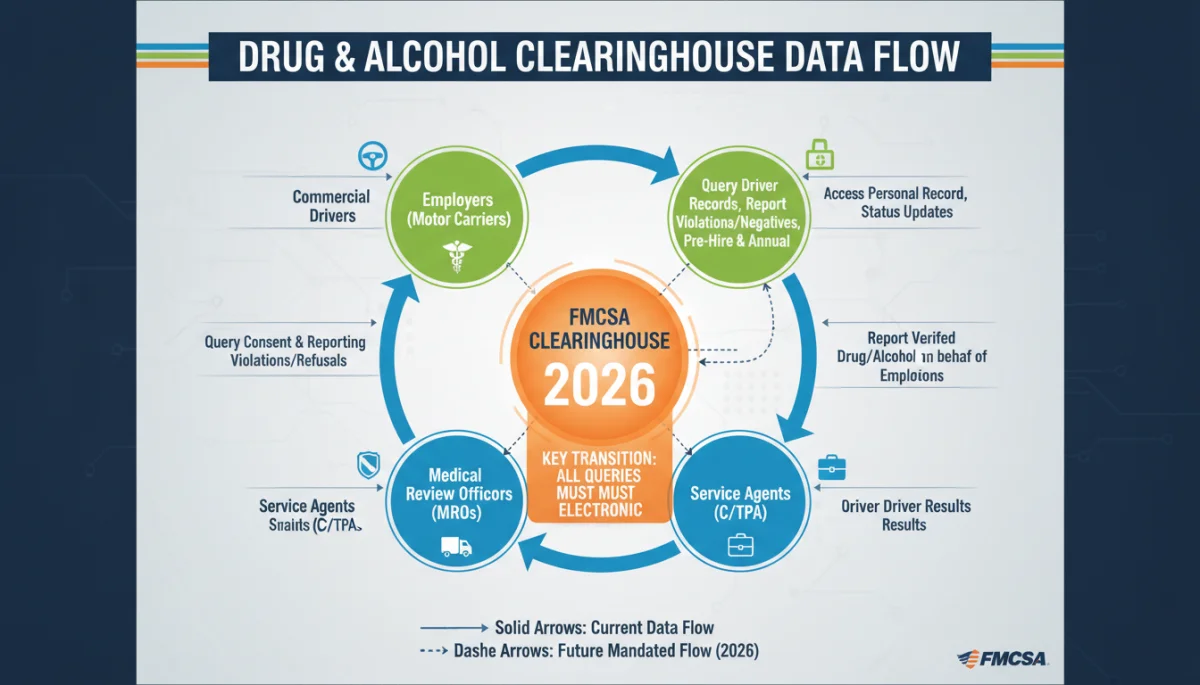
One of the most anticipated changes involves stricter enforcement mechanisms for drivers who fail to complete the return-to-duty process after a violation. The FMCSA is looking at ways to ensure that drivers with outstanding violations cannot simply avoid accountability. This could mean more immediate and severe consequences for non-compliance, such as automatic CDL disqualifications or suspensions.
Expanded Reporting and Monitoring
The scope of reporting requirements may also be expanded. While specific details are still emerging, there is a strong possibility that certain types of incidents or activities not currently captured by the Clearinghouse might be included. This expansion aims to provide a more holistic view of a driver’s compliance history, leaving fewer gaps for potential violations to go unnoticed.
- Broader Violation Categories: Consideration of adding new categories of violations that warrant inclusion in the Clearinghouse, potentially encompassing behaviors that indirectly contribute to safety risks.
- Enhanced Monitoring of Return-to-Duty Process: Stricter oversight and verification of the steps drivers take to complete their return-to-duty process, ensuring genuine rehabilitation and compliance.
- Increased Random Testing Requirements: While not a direct Clearinghouse change, the updates may coincide with increased emphasis on random drug and alcohol testing to complement the Clearinghouse data.
These changes underscore the FMCSA’s commitment to continuous improvement and its proactive approach to ensuring that commercial drivers maintain a high level of fitness for duty. Staying informed about these specific amendments is crucial for every CDL holder.
Compliance Strategies for CDL Holders in 2026
As the 2026 updates to the Drug and Alcohol Clearinghouse draw near, proactive compliance strategies will become even more critical for CDL holders. Navigating these changes successfully requires a clear understanding of your responsibilities and a commitment to maintaining a clean record. The consequences of non-compliance are severe, ranging from temporary suspensions to permanent disqualification of your CDL.
The foundation of compliance remains adherence to all FMCSA drug and alcohol testing regulations. This includes participating in pre-employment, random, post-accident, reasonable suspicion, and return-to-duty/follow-up testing as required. Beyond these basic requirements, drivers should cultivate an awareness of their Clearinghouse record and understand how to access and review it regularly.
Proactive Steps for Maintaining Your CDL
One of the most effective strategies is to register with the Clearinghouse if you haven’t already and regularly check your own record. This allows you to identify any discrepancies or errors promptly and address them before they impact your employment. Additionally, understanding the return-to-duty process in detail is vital, even if you hope never to need it.
- Regular Self-Queries: Perform regular self-queries on the Clearinghouse website to ensure your record is accurate and up-to-date, addressing any potential reporting errors immediately.
- Understand Consent Requirements: Be fully aware of the consent process for employers to query your record and ensure you provide it promptly when required for employment.
- Knowledge of SAP Process: Familiarize yourself with the Substance Abuse Professional (SAP) evaluation and treatment process, should you ever face a violation, to expedite your return-to-duty.
Ultimately, maintaining compliance in 2026 and beyond will hinge on vigilance, education, and a steadfast commitment to operating a CMV safely and responsibly. These strategies empower drivers to take control of their professional standing.
Employer Responsibilities and Enhanced Due Diligence
The 2026 updates to the Drug and Alcohol Clearinghouse will also place enhanced responsibilities on employers of CDL holders. These changes are designed to ensure that motor carriers are conducting thorough due diligence in their hiring processes and maintaining continuous oversight of their drivers’ compliance records. For employers, this means adapting internal policies and procedures to align with the new regulatory landscape.
Employers are already mandated to conduct pre-employment and annual queries of the Clearinghouse for all CDL drivers. The 2026 updates are likely to reinforce these requirements, potentially introducing more stringent penalties for non-compliance or failure to conduct timely queries. This focus on employer accountability aims to create a more robust safety net within the industry.
Strengthening Employer Compliance Frameworks
Beyond standard queries, employers should anticipate a greater emphasis on documenting their compliance efforts. This could include more detailed record-keeping requirements for queries conducted, consent obtained from drivers, and actions taken in response to reported violations. The FMCSA’s goal is to ensure that employers are not only checking the Clearinghouse but also acting decisively on the information it provides.
- Automated Query Systems: Investing in or upgrading systems to automate regular Clearinghouse queries and record-keeping, reducing manual errors and ensuring timeliness.
- Comprehensive Training Programs: Implementing robust training for HR and safety personnel on the latest Clearinghouse regulations and employer responsibilities.
- Proactive Violation Management: Establishing clear internal protocols for responding to and managing drug and alcohol violations reported in the Clearinghouse, including the return-to-duty process.
The shift towards 2026 necessitates that employers view the Clearinghouse not just as a compliance tool, but as an integral part of their overall safety management system, requiring continuous attention and adaptation.
Future Outlook: Beyond 2026 and Continuous Evolution
The 2026 updates to the Drug and Alcohol Clearinghouse should not be viewed as a final destination but rather as another significant milestone in the continuous evolution of commercial driver safety regulations. The FMCSA consistently monitors the effectiveness of its programs and adjusts them based on data, technological advancements, and industry needs. Therefore, CDL holders and employers alike should anticipate ongoing changes and adaptations beyond 2026.
The trend is clear: an increasing reliance on data-driven enforcement and a move towards greater transparency and accountability across the board. Future iterations of the Clearinghouse could potentially integrate with other federal or state databases, further consolidating information and enhancing enforcement capabilities. This continuous evolution underscores the importance of staying informed and adaptable within the commercial driving profession.
Anticipating Future Regulatory Shifts
As technology advances, so too will the methods for drug and alcohol testing and monitoring. Innovations in testing methodologies, data analytics, and digital platforms could all play a role in shaping the future of the Clearinghouse. The FMCSA’s goal will always remain the same: to ensure that only qualified, unimpaired drivers are operating CMVs on our nation’s roads.
- Technological Integration: Potential for integration with in-cab monitoring systems or electronic logging devices (ELDs) to enhance compliance oversight, though privacy concerns would need careful consideration.
- Refined Violation Criteria: Ongoing review and refinement of what constitutes a reportable violation, adapting to new substances or behavioral patterns.
- International Harmonization: As cross-border transportation grows, there might be future considerations for harmonizing Clearinghouse data or regulations with international standards.
Staying ahead of these potential changes requires a proactive mindset, continuous education, and a commitment to safety that extends beyond mere compliance with current regulations. The future of commercial driving is one of increasing scrutiny and heightened safety standards.
| Key Point | Brief Description |
|---|---|
| Stricter Enforcement | Increased penalties and immediate consequences for non-compliance with drug and alcohol regulations. |
| Expanded Reporting | Potential inclusion of new violation categories and enhanced data collection for a comprehensive view. |
| Enhanced Data Integration | Improved connectivity with state DMVs and better data validation processes for accuracy. |
| Proactive Compliance | Drivers and employers must adopt proactive strategies, including regular self-queries and updated training. |
Frequently Asked Questions About Clearinghouse 2026 Updates
The main objective is to further enhance highway safety by strengthening the Drug and Alcohol Clearinghouse’s ability to identify and remove commercial drivers with drug and alcohol violations, ensuring they complete the return-to-duty process before resuming safety-sensitive functions.
The updates may lead to stricter enforcement for non-compliance, including more immediate CDL disqualifications or suspensions for unresolved violations. Expanded reporting could also mean a broader range of incidents impacting your driving record and eligibility.
CDL holders should register with the Clearinghouse, regularly check their personal records for accuracy, and stay informed about all FMCSA drug and alcohol testing regulations. Proactive compliance and understanding the return-to-duty process are crucial.
Yes, employers are expected to face enhanced responsibilities, including potentially more stringent penalties for non-compliance with query requirements, increased emphasis on documenting compliance efforts, and a greater need for proactive violation management.
Official information regarding the Drug and Alcohol Clearinghouse updates, including specific details about the 2026 changes, will be published on the Federal Motor Carrier Safety Administration (FMCSA) website and through their official communications channels.
Conclusion
The upcoming 2026 updates to the Drug and Alcohol Clearinghouse represent a pivotal moment for the commercial transportation industry, reinforcing the commitment to safety and accountability. For CDL holders, these changes underscore the critical importance of maintaining a clean record, understanding compliance requirements, and proactively managing their professional status. Employers, in turn, must enhance their due diligence and adapt their internal frameworks to meet evolving regulatory demands. By embracing these changes and fostering a culture of continuous compliance, both drivers and motor carriers can contribute to safer roads and ensure the long-term viability of careers within this essential sector.
